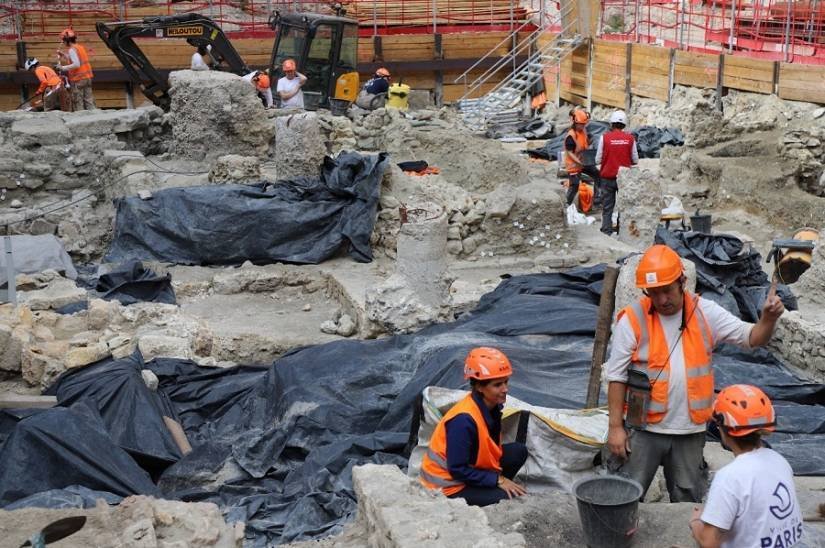
A wall of Gallic origin has been discovered in a courtyard of the Hôtel-Dieu AP-HP (4th arrondissement). Unearthed during an archaeological excavation conducted by the City of Paris and Inrap under the supervision of the DRAC Île-de-France, this vestige could well belong to the enclosure of the oppidum of Gallic Lutetia, mentioned by Julius Caesar but of which no material evidence existed until now.
“We may be looking at one of the most important remains ever discovered for understanding Gallic Lutetia. Scientific caution dictates that its function and chronology still need to be verified, but the convergence of evidence is particularly remarkable” — Catherine Pégard
Why is this discovery exceptional?
Gallic Lutetia was previously known only through the accounts of Julius Caesar. In 53 BC, he went there to convene an assembly of Gauls. In 52 BC, during the Battle of Lutetia , his lieutenant Labienus confronted the Parisii , who burned down their own oppidum (a center controlling communication routes, a place of power and trade) to prevent it from falling into Roman hands.
However, no conclusive archaeological evidence had confirmed the location of this oppidum on the Île de la Cité . The clues in favor of this hypothesis were based until now on the continuity of the toponym Lutetia and on Caesar’s description: an island connected by bridges, in a bend of the Seine.
Source: Major archaeological discovery in Paris: the rampart of Gallic Lutetia unearthed | Ministry of Culture (in French)
Photo: © Anastasia Choquet – DRAC Île-de-France