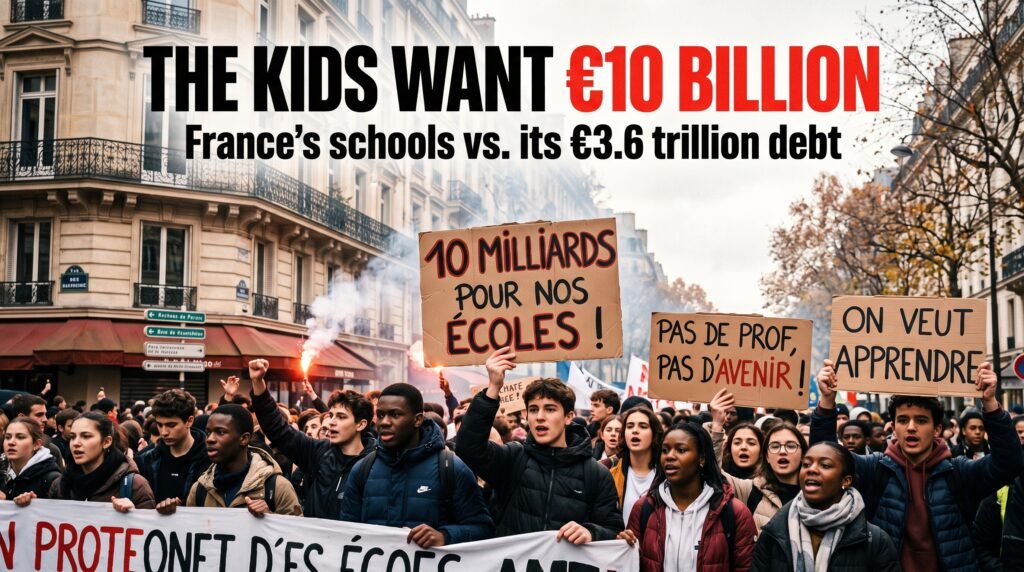
€10 billion for schools = nine weeks of interest on France’s debt.
Remember when you had a substitute teacher ? The one who wheeled in the TV cart, or the one who was just weird. Sometimes you’d get someone qualified to teach your class…other times, you’d get someone who doesn’t know how to teach, anything.
In France, the kids get the free period. When a teacher is out for less than two weeks, almost nine times out of ten nobody walks in: no TV cart, no nothing. Last school year almost one hour in ten of the class time scheduled in French public middle and high schools never happened (9.8%, by the Education Ministry’s own count), and the national audit court counted nearly one in ten back in 2018–19. Some kids went months without a math teacher in the year before their bac.
So in mid-September the staff at one lycée in Créteil, just southeast of Paris, went on strike over empty posts, from an assistant principal to the school nurse. Their students joined the next day and blocked the gates on the 21st.
Three weeks later: 1,027 of France’s roughly 3,700 lycées hit. 256,000 marchers on October 6 by the government’s count, 450,000 by the organizers’. More than 6,600 arrests. Of the 5,060 people held in police custody by October 5, 87% were minors.
On October 8 the Education Minister announced 3,000 substitute teachers. Read the fine print: they’re teachers already on the payroll who didn’t have a posting. The budget didn’t move. The teachers did.
The students want €10 billion. That sounds like a fantasy until you learn that France pays that much in interest on its debt about every nine weeks.
And they’ve won before. In 1990, after hundreds of thousands of lycéens marched, the government found 4.5 billion francs. In 1998, another wave, another plan. Same complaints both times: not enough adults, buildings falling apart.
The teenagers keep winning the money. Nobody fixes the system that keeps running out of it.
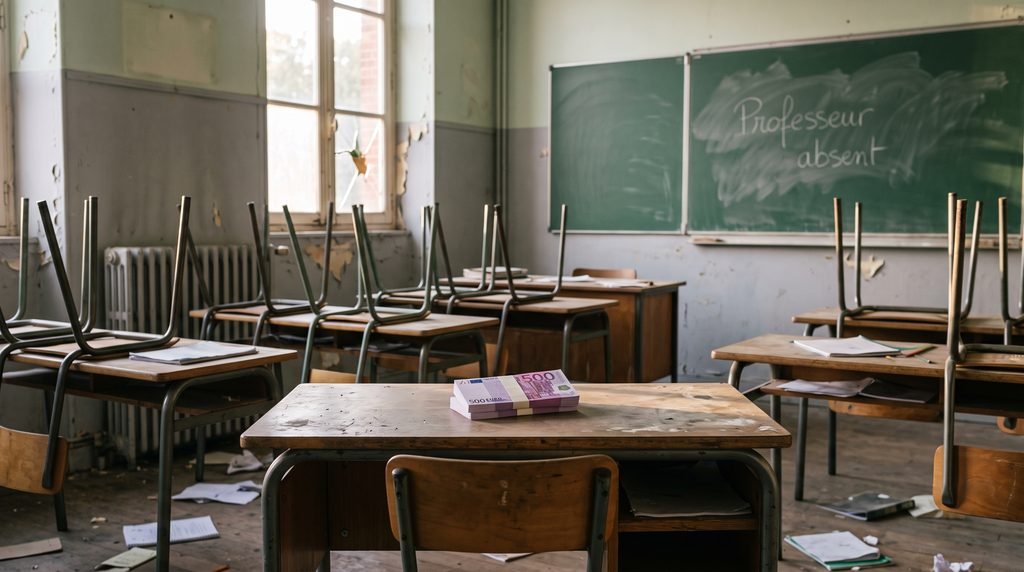
Why a missing teacher is a crisis here
In the US a missing teacher is an inconvenience. In France it lands on your future, because of two acronyms.
The bac is the national exam at the end of lycée. Parcoursup is the national platform that sorts every student into higher education, and it reads your grades from the last two years of lycée. No physics teacher for four months means no physics grades, or thin ones, in the file that decides where you study. One of the student unions, the USL, is now asking for Parcoursup to be abolished altogether.
If a strike over missing staff sounds backwards (cancel even more classes to protest cancelled classes ?), it’s the standard French move. A strike at one school is the quickest way to get the rectorat, the regional education office that does the hiring, to pay attention, and every striking teacher pays for it with a day’s salary. When the students joined, the rectorat had a school it couldn’t ignore. Now teachers and students are on the same side of the same fight: the teachers’ unions want the teaching posts cut in the 2027 budget put back.
Then there’s the room itself. A 17-year-old in Strasbourg told France 24: “There are 35 of us per classroom. With 35°C in summer, it’s unbearable.” The demand list is long and boring in the way real problems are: teachers, supervisors, school nurses, leaking roofs, too few toilets, a cafeteria too small for the school.
All of this is happening while the government is trying to find savings for the 2027 budget. Teacher unions count well over a thousand secondary teaching posts cut for this school year (their figures differ by source).
The parents are split
The FCPE, the largest parents’ federation and historically on the left, backs the students’ demands and condemns the violence. Its Bouches-du-Rhône branch asked parents to show up in FCPE vests and form cordons around the October 6 march to keep outsiders out. In Paris, parents gathered outside Lycée Condorcet to “protect” students from the police.
The PEEP, the other big federation, said a concrete answer on such a short timeline looked impossible.
And plenty of parents simply told their kids to stay home. Their fear is a police record or a hospital visit, not the cause.
The government has added a new reason to worry. A bill nicknamed casseurs-payeurs (“you break it, you pay”) would make individuals liable for damage done by a group, up to €10,000 a head. Under French civil law, parents answer for damage done by their minor children. You can do the rest of that math yourself. The Senate takes it up on October 27.
Who pays
My first question, before any of this, was whether the people who protest ever end up better off. In this case the costs are already visible, and they land on individual teenagers.
A 16-year-old in Tours lost the use of his right eye. On October 5 a 15-year-old in Lens lost his hand in a blast during clashes outside a lycée, and two days later the government suspended one type of stun grenade for the school protests. The IGPN, the police’s internal investigators, has opened 18 inquiries.
The protests are also costing class time, which is the thing they’re about. Geffray told the National Assembly that 24 lycées have been burned or ransacked, leaving about 30,000 students without in-person classes.
Then there’s the politics. The presidential election is about seven months away. The government calls the violence “urban violence” and says intelligence links its organization to the radical left; LFI calls that conspiracy thinking. Both sides will use these weeks in the campaign. France has seen this before: in May 1968 the students shut down the country, and in the June elections de Gaulle won a landslide.
The scorecard
French students have one of the best protest records in the democratic world, with an asterisk.
- 1986: university students and lycéens marched against the Devaquet bill, which would have let universities select students. After Malik Oussekine, 22, died following a police beating, the bill was withdrawn and the minister resigned. Won.
- 1990: the lycéens marched over means and safety and won the 4.5-billion-franc emergency plan. Won the money.
- 1998: another wave, another plan. Won the money again.
- 2006: students and unions marched against the CPE, a youth job contract with weaker protections. The government withdrew it within weeks. Won.
- 2018: lycéens protested the bac and Parcoursup reforms. In Mantes-la-Jolie, police made 151 students kneel with their hands on their heads, and the video went around the world. The reforms went through. Lost.
- 2023: lycéens joined the pension protests. The reform passed. Lost.
The pattern: students win when the demand is “withdraw this law,” because a government can drop one bill and move on. They win money when the demand is “give us the means,” but that money arrives once and the shortage comes back about a decade later. They lose when the government has tied its credibility to the reform.
This year’s demand is the hardest kind: spend €10 billion, during a budget squeeze, seven months before an election.
Why the money never sticks
The scorecard has a pattern, and i wanted to know why, so i went to the people who study this for a living. Four findings explain most of what’s happening at those gates.
More than half the lost hours aren’t a money problem. A National Assembly finance committee report filed on September 29 took last year’s 9.8% apart. Teachers out sick, on parental leave or on strike, with nobody sent in: 4.3 points. Everything else came from the system itself. Teachers called away for exams and committees: 1.9. Teachers away at training: 1.3. Whole schools closed, mostly to run exams: 2.3. The audit court found the same pattern in 2018–19, when two unreplaced absences out of three came from the way the ministry organizes its own work. Money doesn’t fix a calendar. Somebody has to change it.
The rest is Beethoven’s problem. In 1966 two economists, William Baumol and William Bowen, set out to explain why orchestras and theaters never seem to have enough money. The example everyone remembers is a string quartet. Playing one of Beethoven’s still takes four musicians and as long as it did in his day, and nobody can make it more productive. But the cellist can quit for a better-paid job, so the quartet has to keep raising pay just to stay a quartet. Economists call it the cost disease, and a classroom has it too: one teacher, one room, one hour. When teaching pay falls behind what a math graduate can earn elsewhere, math graduates go elsewhere, and France is already short of them (more on that below). A one-off plan buys a few years, then the disease comes back. That’s the scorecard: 1990, 1998, 2026.
The kids who can least afford a lost hour get the weakest replacement. A team at the Harvard Graduate School of Education (Raegen Miller, Richard Murnane and John Willett) measured what teacher absence costs in one American school district: every ten days a teacher was out measurably lowered students’ math scores. An economist, Asma Benhenda, asked the same question of French ministry records and found that a certified substitute makes up at most a quarter of the damage. A contract substitute makes up none that she could detect, and contract teachers are concentrated in disadvantaged schools, where pupils appear to be hit hardest. Meanwhile the pool of tenured replacement teachers, the kind that helps, has shrunk by more than a third in twenty years, by the audit court’s count.
The system runs on fire alarms. In 1984 two political scientists, Mathew McCubbins and Thomas Schwartz, described two ways a legislature can keep watch over a bureaucracy: police patrols, where you check all the time, and fire alarms, where you wait for someone to scream. They meant it as a point in the alarm’s favor: it’s cheap for the people in charge. France has done the patrolling. The ministry counts every lost hour, and the audit court, the Senate and the National Assembly have all written reports on them. The ministry’s own budget documents set a target of 1.5% of class hours lost; it missed it and, in the 2025 budget bill, pushed the deadline to 2027. The patrols did move one number: since the 2023 “teacher pact” started paying volunteers to cover short absences, the share covered has gone from 4.5% to 11.6%. Then one lycée in Créteil went on strike, and within ten days the ministry had promised to fill its empty posts. Three weeks in, with blockades across the country, the minister found 3,000 teachers. The alarm is cheap for the government. The people pulling it are teenagers, and they’re the ones in police custody.
Teenagers can pull the alarm, and they can’t stay to finish the job. In 1965 the economist Mancur Olson asked why large groups so rarely act on a shared interest. Every student benefits from more teachers whether or not she marches, so why march ? Olson’s answer: it takes a private reward or a little coercion. A blockade supplies the coercion. Once the gate is shut nobody has class, so marching costs nothing, which is why lycéens can fill the streets in three weeks when their parents can’t. It’s also why they lose the long game. Lycée lasts three years. By 2029 almost every kid at those gates will have graduated, and nobody will be left to check whether the 3,000 teachers are still there.
Put it together and the scorecard makes sense. Teenagers can force a government to write a check, because a blockade makes marching free and a government under alarm pays to make the noise stop. They can’t force it to fix the calendar, keep pay rising, or rebuild the replacement pool, because that takes ten years and the kids are gone in three. So the money arrives, the alarm goes quiet, and the shortage comes back. Nobody marches for a calendar.
Where would €10 billion come from ?
Living here, i always assumed France had a bottomless purse. Every crisis seems to come with a check. So i looked it up.
France doesn’t have endless money. It has very high taxes and a very large credit card.
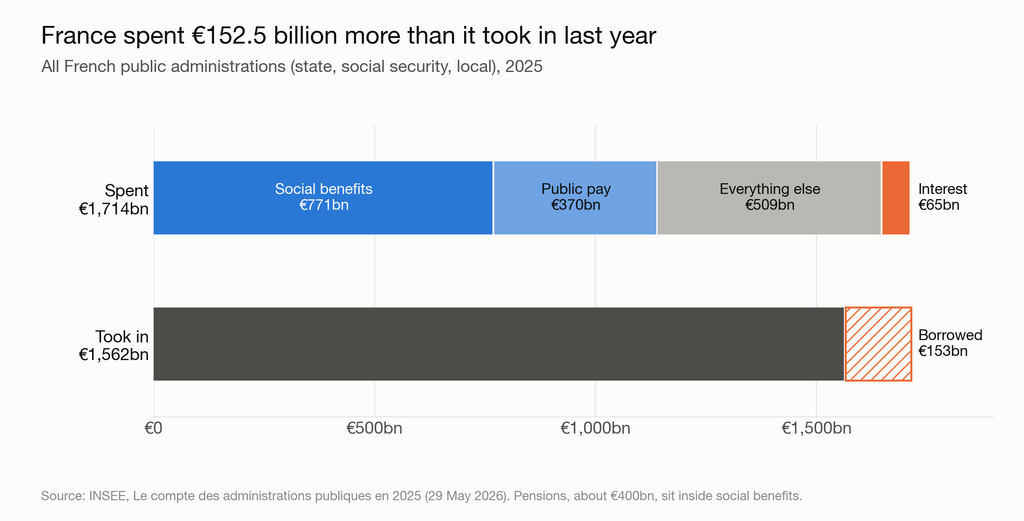
In 2025, French public administrations (the state, social security and local government together) spent €1,714 billion and took in €1,562 billion, according to INSEE. The gap, €152.5 billion, was borrowed. That’s 5.1% of GDP, against an EU ceiling of 3%. And this is with taxes already at 43.6% of GDP, which the Cour des comptes (France’s national audit court) calls the highest rate in the eurozone.
The biggest block of spending is social benefits, €771 billion, and roughly half of that is pensions. Then come public employees’ salaries, €370 billion. Those two are most of the budget, and neither one moves easily. Any government that touches pensions gets a strike, as the last few years have shown.
And then there’s interest.
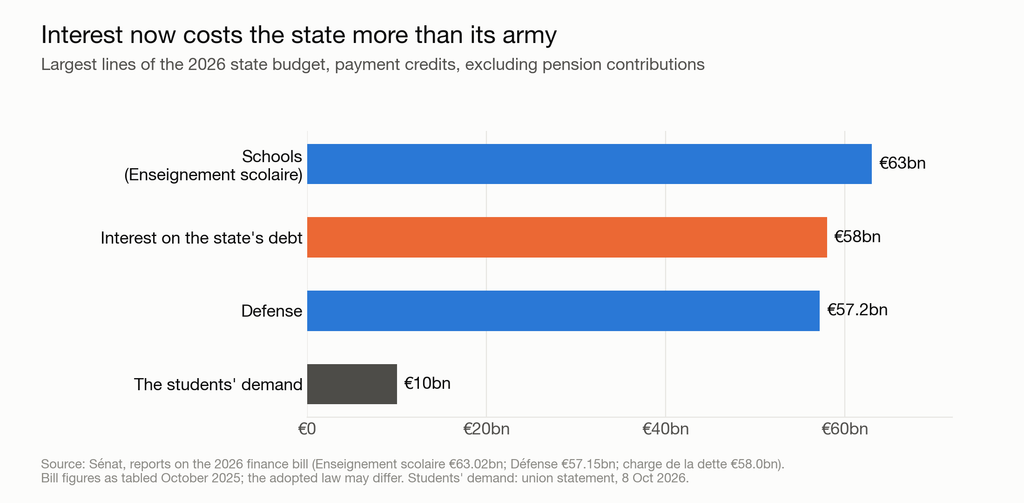
In the 2026 state budget, interest on the debt (€58 billion) comes in above the entire defense budget (€57.2 billion), and just under the whole schools budget (€63 billion). The Senate pointed this out itself when it reviewed the bill.
Put the students’ demand next to those lines and it looks modest: €10 billion is about 16% of what the state already spends on schools. It’s also what the state pays in interest roughly every nine weeks.
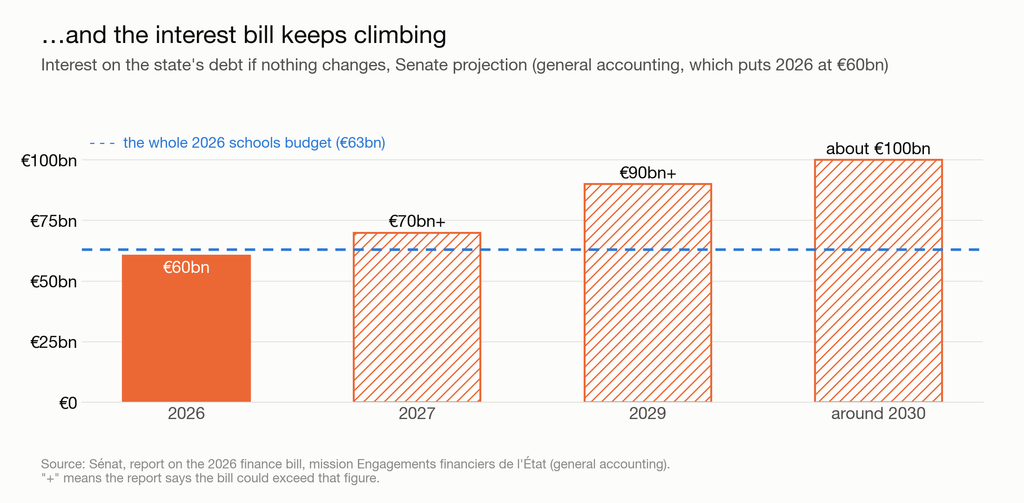
The trend makes it harder. The national debt stood at €3,595 billion at the end of June 2026, 119% of GDP, up from 115.7% at the end of 2025. If nothing changes, the Senate projects the interest bill passing €70 billion in 2027, €90 billion in 2029, and about €100 billion around 2030. The Cour des comptes estimates another €80 billion of savings or new taxes is still needed just to get the deficit back under 3%.
Which is why Geffray could find “3,000 teachers” in a week without finding any new money.
A history footnote, because i can’t resist one in this country. My first instinct was that France is just Louis XIV with a credit card: spend, spend, spend. The better comparison is his great-great-great-grandson. Louis XVI inherited the debt, and by 1788 the crown was so close to bankruptcy that it called the Estates-General to raise money. They met in May 1789. You know how that went.
Is it too much to ask ?
i’m on the side of education. i usually am. Which is exactly why i made myself argue the other side before deciding anything. Below is the case against the students, as fairly as i can make it, with what the numbers say back.
“Money can’t buy teachers who don’t exist.” This is the strongest one. France isn’t only short of teaching posts; it’s short of people willing to fill them. In the 2025 recruitment exam for secondary math teachers (the CAPES), about one post in four went unfilled, 253 of them, according to the SNES teachers’ union; the ministry’s own figure is 74.4% filled. You can put €10 billion on the table tomorrow and there still won’t be a math teacher in Créteil on Monday.
What the numbers say back: French teachers are paid less than the OECD average by mid-career (about $53,000 a year for a secondary teacher with fifteen years in, against an OECD average above $61,000, per the OECD’s Education at a Glance 2025). If nobody wants the job, the pay is part of why. So money can’t buy teachers this year, but the shortage itself is partly a money problem.
“France already spends a lot.” True. France spends 24% more per lycée student than the OECD average ($18,127 against $14,562, same OECD report). Whatever the problem is, it isn’t that France is stingy with lycées in general.
What the numbers say back: if spending per student is high and teachers’ pay is low, then the money is going somewhere other than teachers’ salaries. That’s a question for the ministry, not the teenagers.
“There are fewer kids every year.” France’s birth rate has been falling, and the ministry expects 160,000 fewer pupils this school year and 180,000 fewer next year. The government says that’s why the 2027 budget cuts 1,588 teaching posts, far fewer, it says, than the 9,600 the drop alone would justify.
What the numbers say back: the drop hits primary schools first. By the ministry’s own statisticians’ projections, general lycées don’t start shrinking until around 2028. The kids blocking the gates are in the classes that haven’t shrunk yet.
“Blocking schools isn’t how you get more school.” Twenty-four lycées burned or ransacked and 30,000 students out of their classrooms, by the minister’s count, and students who wanted to go to class kept out by those who didn’t. That argument doesn’t need numbers.
“The movement is being used.” This is the government’s line. Two LFI deputies visited the Créteil lycée on September 21, and the presidential election is seven months away. LFI’s answer is that it called for non-violent protest and that the government is “sinking into conspiratorial thinking.” Both things can be true at once: a real grievance, and politicians who’d very much like to be photographed next to it.
“Abolish Parcoursup” is a different kind of demand. Parcoursup is the sorting machine, not the reason there aren’t enough places. Scrap it tomorrow and France still has to decide, somehow, who goes where. That demand is about something bigger than teachers.
So is it extravagant ? Asking for a teacher in front of every class on the timetable is not extravagant. It’s what the timetable already promises, and the ministry wrote a 1.5% target into its own budget documents. The €10 billion is another story. Nobody has shown me how they got to that number, more than half the lost hours would need a new calendar rather than a check, and a lump sum is the cure that has already worn off twice. The honest objection is the one the PEEP parents made the day Geffray announced his plan: a real answer can’t arrive this fast. The kids are right about the missing teachers and wrong about the price. The people who could fix it are waiting for the next alarm.
An opportunity for expat teachers ?
i’ve been teaching music since 1987, so when i read that France can’t find teachers, my first reaction was: i’m a teacher ! Hire me ! So i looked up what it would take. A non-EU resident can be hired as a contractuel, a contract teacher, with a work-authorized residence card and a bachelor’s-level degree in the subject. No national exam. Then i read the fine print: contract teachers go where the empty posts are, and the empty posts are in Créteil and Seine-Saint-Denis. And i realized i didn’t want to go there either.
The jobs are exactly where nobody wants to go. That’s the whole problem in one sentence, and i’m part of it.
i can’t vote (yet) in France. i don’t have a candidate and i don’t have a kid in a French lycée. What i have is thirteen years of watching this country argue with itself in the street, and a strong suspicion that the 3,000 substitutes will arrive, the blockades will thin out, and in 2036 another kid in Créteil will be sitting in a room of 35 with no math teacher.